06 February 2007

Hopeless in Boston?

to be posted at SportsBlurb.com and SportingNews.com February 7th.

The headlines in Boston scream: “Bruins are frozen in place.” “It’s now embarrassing.” and “Pitiful loss puts jobs on the line.”

Such is the state of the Boston Bruins, members of the National Hockey League since 1924 and winners of just two Stanley Cups since 1941. That fact hasn’t been seriously threatened for 15 years and isn’t likely to change anytime soon. How did this happen? How did a once-proud franchise fall so far as to lose the stranglehold grip they once had on the fans of New England - first with the Big Bad Bruins of the 1970s with the great Bobby Orr, Phil Esposito, Johnny Bucyk and Don Cherry, then followed by a minor revival with the late 80s-early 90s exciting squads that starred Ray Bourque, Cam Neely, and Adam Oates?

General Manager Peter Chiarelli is currently suffering through his first year at the helm of the Bruins, inheriting a team not quite sure whether they're still in a full rebuilding mode or looking to move up into the ranks of challengers in the Eastern Conference. Before the season started it appeared that the Bruins were poised to at least make a little noise in the middle of the conference and stand a decent chance at grabbing one of the final playoff spots. Even up until a month ago they were certainly on pace to do just that, but a January in which the team went 3-10 left them flirting with the bottom of the Eastern Conference (non-orange-and-black division).

So where are the breakdowns? A scouring of the roster both at the NHL and AHL levels shows that there appears to be precious little depth in the organization. At the top level, only four players are even in double-digit figures for goals (although I do expect Brad Boyes - nine goals - to have a bright future in front of him, despite a lousy season thus far) and only New Jersey and Philadelphia have fewer goals in the East. Defensively, the team has given up more goals than any Eastern team save the Flyers. Tim Thomas, although not generally considered in the upper echelon of NHL goaltenders, has done a serviceable job in net for the Bruins with very little support from the team in front of him. Nobody on the team is even close to a + rating with ten players at -10 or worse. These are not numbers that show a lot of promise.

Of course when Bruins fans try to pinpoint where the final stone was toppled to expose the organization’s flaws, the ill-fated Joe Thornton trade to San Jose is almost inevitably offered up. However, things didn’t have to go sour as a result of that deal. Last year after the fallout of the big trade, I wrote the following:

...Thornton’s departure should have sent a clear sign to the rest of the club that they are the future. It’s a new opportunity for the team. Thornton is a great talent but for a variety of factors it wasn’t happening in Boston. ... The Bruins may not have received “name-players” back in the deal but all three were former first round picks, including Brad Stuart who should anchor their blue line for a long time...there comes a time when you have to realize that “the plan” (whatever it may be) isn’t working, and you have to start over. That’s not easy, least of all from a marketing or fan perspective...but building from the ground up can be rewarding as it inevitably is the most efficient way of assembling a team that will compete year after year…


Most importantly, what the trade gave
Boston was roster and payroll flexibility. Not a phrase that rings with excitement for the average fan, granted, but Thornton was being paid a large percentage of what the entire team salary cap allowed. Furthermore, lest fans begin to create their own revisionist history, big Joe wasn’t exactly being worshiped by fans of the Black and Gold early last year. Some of the more polite terms to describe him around Boston were “lazy” and “ineffective” and more than once in his career he’d been accused of disappearing in big games. I’m not going to defend or attack those accusations, but the idea of Thornton leaving wasn’t so controversial in the days before the deal was made.


However, fast-forward 15 months later and the rumours that two of the parties obtained in last year's big deal - Brad Stuart and Marco Sturm - are being shopped should be more than troubling to Bruins' fans for a few reasons.
Boston's management knew that the Thornton deal would be controversial in that they were giving up the biggest "name" player, so a little PR was necessary and understandable. They needed to stress to their ever-dwindling fan-base that patience would be needed for this deal. But what kind of message will those fans take if and when just two seasons later all those players received as compensation – for the eventual league MVP - are gone? The message would either be that the trade was a dreadful mistake, or management is sadly incompetent and has no plan. Neither sounds particularly appealing.

Other recent trades have also been peculiar. Dealing Sergei Samsonov away at last year's deadline was defensible, both on his play at the time and especially since (note: Samsonov was placed on waivers yesterday by
Montreal). Samsonov had teased fans with occasional brilliance for years (notching 70+ points for two seasons) but never reached that next level that so many had expected of him, while seeing other similar exciting offensive players like Ales Hemsky and Maxim Afinogenov rocket by him in production. Yet there does not appear to have been a plan to replace his offence; gaining Marty Reasoner and Yan Stastny (as well as a second round draft pick) seemed to be a bit of the Bruins trying to have it both ways - quantity and youth. We'll never know what the options may have been at the time, but it seems that even getting just a pick would have meant a full commitment to housecleaning, and one that could be addressed in the offseason.

This week came another puzzling deal, if you could even call it a trade: big defenceman Milan Jurcina was dumped to the Capitals for a 4th round pick. I’m left wondering if there was more to this story. The 2006 Slovakian Olympic rearguard was re-signed as recently as August; at 24 years old he was known to be a work-in-progress but what could have happened in such a short time for them to completely give up on the 6’4” 235 pounder?

Last summer’s free agent period saw the Bruins make an early splash by signing Marc Savard and Zdeno Chara to lucrative long-term deals, giving Bruins fans hope that the team’s fortunes would turn around this season. Savard has been better than most people expected and
Boston's best player all year. Many pundits - myself included - expected to see a dropoff in Savard's production, having left prolific linemates Ilya Kovalchuk and Marian Hossa behind in Atlanta but instead Savard is on pace for his best season statistically with 66 points in his first 51 games.

Chara’s signing is one still being evaluated. He has given the Bruins a clear-cut number one defenceman, their first since Ray Bourque left for
Colorado in 2000. Yet while establishing himself as Boston's iron man - playing nearly 29 minutes per game and notching 35 points to date, he has yet to show the consistency he has been paid for or even that he showed last year with Ottawa. Named captain before the season, he has at times also shown a distinct lack of visible on-ice leadership, whether by inspired play or simply dropping the gloves and getting tough when necessary.

The issue of the sheer magnitude of Chara's contract can also not be dismissed - my biggest defence of last season's
Thornton trade was that by eliminating a player who earned roughly one sixth of the team's entire payroll the franchise gained valuable flexibility. Yet by turning around and signing Chara to a deal that pays him $7.5 million per year for five years, the Bruins have created the same potential inflexibility in their payroll with arguably a lesser player.

Finally, and perhaps most importantly, the Bruins’ recent draft history has been simply terrible. Since the 1997 draft, in which they famously obtained both Thornton and Samsonov in the first round, the number of players who've thus far put together a successful NHL campaign can be counted on one hand, and finding success in each draft has been a stretch:

Goalie Andrew Raycroft - drafted in 1998 - put together a Calder trophy winning season in 2003-04, but after one sub-par year was dealt to Toronto in the offseason. Nick Boynton was drafted in 1999 and showed glimpses of being the tough defenceman the team had hoped he'd be, but his lack of development and adjustment to the modern game caused the team to deal him away to
Phoenix last summer. 2001 brought them Milan Jurcina and another defensive defenceman in Andrew Alberts out of Boston College; Alberts has played a solid but unspectacular role with the club and has become a serviceable fourth or fifth man on defence. 2002 first rounder Hannu Toivonen was supposed to strongly challenge for the number one job in net this year but after a horrible start lost the job to Tim Thomas and has spent time with the AHL Providence club trying to regain his confidence. Boston's second-round pick in 2003 has to date been their best selection since '97 in Patrice Bergeron. Last year's draft netted highly-regarded sniper Phil Kessel out of the University of Minnesota.

That’s pretty much it in terms of “hits” for a decade of drafting. Teams such as New Jersey or Buffalo have had a recent history of rarely missing completely with one draft and never whiffing on consecutive drafts, which has contributed to those organizations’ abilities to continually bring up new talent to fill gaps where older (or more costly) veterans may have left. By virtue of this long string of poor drafting Boston has not allowed themselves the luxury of letting their farm system replenish any losses by the parent club.


So what can the Bruins do? First, they – and perhaps more importantly their fans - are going to need patience. This is a project, but they have to fully buy into the project. Here’s a short list of what I think the Bruins could do to start to bring themselves back to the world of contention within a few years:

1) Deal Glen Murray. With 26 goals on a bad team, he’s the team’s most marketable asset and is likely at peak value. He could fetch a decent return of a prospect or two from a playoff team desperate for veteran scoring depth. Plus at his current US$4.15 million salary over the next two seasons it would free up a good amount of cap room.

2) Put Phil Kessel on the top line. Why on earth is he on the fourth line? He's a scorer, he was drafted as a scorer: let him score. If the team were more successful and contending, putting Kessel in a specific learning role would make more sense for him and the team (as Joe Thornton was used in his rookie year). Kessel is going to need to build up confidence and learn how to fail at some point - let him do that to his advantage, by using his skills and not being afraid to screw up. A little confidence goes a long way.

3) Emphasize youth. Don't send a split message here - Chara/Savard/Bergeron are each signed for at least the next three years and should be a solid core. With only approximately $31 million committed in salaries next year, the temptation could be to sign big name free agents. Resist. Use the flexibility to deal a veteran or two (Murray, perhaps Paul Mara) and truly build. That means the team should aim to begin contending in two or three years, not next year. Signing a big name free agent like Chris Drury might bring in a few fans in the short run but one skater alone will never make a difference in hockey for a team looking to improve upon what is now a 13th place standing. And by the time the team could potentially be ready to contend, Drury (and his likely $6 million contract) will be aging and again up for free agency. Free agency should be used as a final piece in the puzzle for Boston, not part of the initial building process itself.

Boston fans shouldn’t give up all hope – despite recent history, turnaround doesn’t have to take years but it does require a full organizational commitment. Unfortunately, whether the Bruins’ front office fully realizes this is a question as-yet unanswered, and over the next few weeks approaching the trade deadline we should learn more about what Peter Chiarelli has in mind for the future of the historic Boston Bruins.

is there a chill in here?

Tuesday's Toronto Sun reports that Mark Messier has rather aggressive designs on the GM job in New York...

Mark Messier didn't finish the sentence.

He told reporters at the NHL all-star game that he has decided he wants to be a general manager.

In fact, he wants to become general manager of the New York Rangers!

Messier told Sun Media yesterday that he wants to take over from his former coach and GM when Glen Sather retires from the job in New York. Messier led the team to a first Stanley Cup since 1940 back in 1994.

Furthermore, Messier said he has decided to get pro-active about it.

He's planning to move back to New York and make it his primary residence and plans to talk to Sather about the idea after his Feb. 27 banner-raising in Edmonton.

"I'm going to have discussions with Glen. I don't know how long Glen is going to keep doing it. Maybe he'll continue for another five or 10 years.

"I just know New York fits best for me and my family. And this is what I know best and what I love the most," Messier said of taking two years away from the game to think through what he'd like to do with the rest of his life. He retired as a player in September 2005.


"I'm going to have discussions with Glen."

If I were Glen, that "discussion" might be a little terse.

Now aside from being "MARK MESSIER"tm why should anyone think Messier would automatically be a great or even good GM? Is there a possibility that he's not far enough removed from the game to take an objective look on players?

I have no way of knowing Messier's potential managerial style but would it entirely surprise anyone to see Messier surround himself with confidants and old friends, not unlike certain other former legends?

Even-strength scoring

As of February 6th, take a look at the NHL's leaderboard for even strength points:

RK Player Pos Team GP G A P +/- ESP SHP PwPP P/G
1 DANIEL BRIERE C BUF 54 21 44 65 15 44 0 21 1.20
2 SIDNEY CROSBY C PIT 49 25 59 84 11 43 0 41 1.71
3 ALEXANDER OVECHKIN L WSH 54 33 37 70 -14 41 0 29 1.30
4 PAUL KARIYA L NSH 54 17 41 58 14 41 0 17 1.07
5 DANY HEATLEY R OTT 54 31 36 67 20 40 2 25 1.24
6 MARTIN ST. LOUIS R TBL 54 32 40 72 4 40 6 26 1.33
7 VINCENT LECAVALIER C TBL 54 33 36 69 6 39 5 25 1.28
8 JAROME IGINLA R CGY 41 24 34 58 14 39 1 18 1.41
9 THOMAS VANEK L BUF 54 25 26 51 26 38 0 13 .94
10 ALEX TANGUAY L CGY 51 15 35 50 15 38 0 12 .98
11 RAY WHITNEY L CAR 55 21 38 59 1 37 0 22 1.07
12 MAXIM AFINOGENOV R BUF 49 21 34 55 13 36 0 19 1.12
13 JAROMIR JAGR R NYR 53 19 44 63 12 35 0 28 1.19
14 JASON POMINVILLE R BUF 54 23 20 43 21 35 3 5 .80
15 OLLI JOKINEN C FLA 54 22 31 53 0 35 1 17 .98
16 DANIEL ALFREDSSON R OTT 49 19 32 51 20 35 2 14 1.04
17 DAYMOND LANGKOW C CGY 52 22 32 54 23 35 2 17 1.04
18 DAVID LEGWAND C NSH 51 18 27 45 27 35 3 7 .88
19 ERIK COLE L CAR 54 24 25 49 0 34 1 14 .91
20 MICHAEL NYLANDER C NYR 50 18 39 57 6 33 0 24 1.14


Special teams are obviously important, and it all counts the same on the scoreboard, but it's interesting to see who might be more of a contributor (or less...) than is seen on the official leaderboard.

If Buffalo ever gets their powerplay going, look out...

01 February 2007

gratuitous RJ video

I'd never seen this one - from TSN during last year's playoffs. Contains some of his alltime classics:

29 January 2007

Can people please stop bitching about the schedule?

to be posted at SportsBlurb.com and SportingNews.com

Enough already about the schedule.

Perhaps the biggest off-ice story in the NHL over the past week (besides the $450 price tag for a new official NHL robot-jersey) was that after a year of pillow-talk, the NHL finally decided to not alter the schedule for next year with the vote falling one short of official approval. There was everything short of absolute promises from the league to alter the schedule next year to insure that every team faced each other at least once, which would alleviate apparent concerns that not every fan had the opportunity to see every other team.

So now it’s my turn to moan about the NHL and their schedule but I'm apparently in the minority in that I don’t mind that the present schedule stays as is. I've never understood the outcry about the schedule in the first place. As a frequent critic of the regular season for other reasons (unnecessary length, best teams not rewarded come playoff time), anything that legitimizes the regular season and the (artificially created) divisions is a good thing. A good schedule is one that encourages and develops rivalries – therefore seeing a roughly balanced schedule with 30 teams in six divisions where each team plays every other team two or three times just doesn’t make sense. Why not just lump all 30 teams together, take the top 16 at the end of the regular season and have a standard bracket where the top team plays the worst? (…and no, I wouldn't endorse that either...)

Yes, some or most of the criticism involves the apparent desire of fans in the Western Conference cities to see
Pittsburgh's Sidney Crosby and Washington's Alexander Ovechkin, but that's a convenient way to summarize the position using high-profile examples. If an unbalanced schedule means a Montreal Canadiens fan never gets to see their team play against Jarome Iginla or Joe Thornton – I say that’s just too bad. In that specific case I’d like to think there would be more interest in both the short and long term in seeing them battle the Bruins six or seven times and foster some good old hatred again.

But here’s the rub – why is it so difficult to find a compromise that works for everyone? There are 30 teams evenly distributed among six divisions. The present playoff format rewards you for winning your division, so to make it meaningful you need to play a bulk of games against the four other teams in your division. How about six games against each team in your division (24 total), three against each of the others in your conference (30), and two against each in the other conference (30). That would give you 84 games total. Everyone gets a home and home against every team in the other conference to see how the other half lives. And you still play nearly 65% of your games within your own conference, (which to me is necessary because that's who you're battling for playoff position with), including six games against each divisional opponent. To make it even better, make it only two against your other conference foes, dropping the schedule to a much more palatable 74. There - was that so hard?

Another frustrating (and somewhat controversial in some corners) aspect to the argument of schedule restructuring is the fact that, frankly, just not that many people are interested in a lot of the newer NHL markets. And to be clear, it’s not just crusty old-time hockey fans or diehard traditionalists (guilty-as-charged, somewhat…). For instance, last month during a Detroit/Columbus telecast the network posted the upcoming schedule for the Red Wings. They'd played Columbus twice in a row, and were about to play Minnesota three consecutive games and then Columbus again. The announcer himself said that no Wings fan wants to see Columbus three times and something about "that's not a way to sell tickets." Which begs the question…why did the NHL expand again?

And in the end, there's the hard truth: this entire debate about the schedule is – as always in the NHL – masking a deeper problem. I understand how 32 games against divisional opponents that aren't really rivals could feel oppressive and repetitive. But can't anyone see the inherent answer here? There are too many teams. You've heard it time and time again, but the fact remains: there are too many teams, and in too many markets that don’t draw interest either locally or nationally. With 30 teams it is impossible to satisfy all angles - you can't have a meaningful schedule that emphasizes rivalries because for every Montreal-Boston, Buffalo-Toronto, or Calgary-Edmonton series of games you have
Columbus-Nashville, Florida-Washington, or Anaheim-Phoenix. I apologize to diehard fans of those teams, because I personally know they exist. There just aren't many of them, and certainly not enough to make this entire grand "let's make the NHL all things to all people" experiment anything but a horrible waste of nearly 15 years. Amazing how the suits can't see the logic (or lack thereof) here, and only have cared about the initial franchise fees they get to divvy up. The NHL expanded into far too many markets that not only nobody else cares about, but can't even generate interest locally (Nashville, Phoenix, Florida, Atlanta, Carolina - before you jump down my throat at the Carolina reference, they had to give tickets away during last year’s playoffs and tried restricting sales to out-of-town fans). So now there are so-called "schedule problems" because teams want to see more rivals.

My compromise schedule idea above shows how to emphasize (or force) rivalries while still seeing every team in the league using the present 30 team league. I know I'm not alone in thinking this, but if the league were to contract (and strengthen) itself to 24 markets (hint: not all present markets) I can't see how it wouldn't be stronger.


Since I’ve completely moved into fantasy-land here, just for fun take a look at this hypothetical divisional setup, under a more reasonable expansion over the past 15 years and see if you can’t see some great rivalries. Each team plays each divisional rival six times, each other team three times, giving you 84 games. I'd prefer less, so you can toy with the scheduling a bit (divisonal rivals eight times, other teams play a home and home and you have a nice 76 game schedule). Again, this is one person's (me) idea of a potentially streamlined NHL (and i'm not referring to the Reebok 9% faster uniform) that could have had excitement and rivalries every night:

Ottawa
Buffalo
Montreal
Boston
Toronto
Columbus

Philadelphia
NY Rangers
NY Islanders
NJ Devils
Pittsburgh
Washington

Detroit
Colorado
St. Louis
Chicago
Dallas
Minnesota


Vancouver
Calgary
Edmonton
Winnipeg (franchise move - take your pick)
San Jose
Los Angeles

===============

UPDATE: that was my "kind" article. here's how i really feel, as posted on SportsFrog:


fuck. i tried to be nice (not really, but i say it anyways). fuck Bettman and his NHL. fuck it all. we need a fucking revolution. 30 teams? fuck you Gary - get lost. you win the Cup and you're giving away tickets during the final two rounds?? WHAT?? gone - sorry Carolina. First place in your division and you're in the bottom third of attendance? sorry Anaheim and Atlanta (we gave you your chance in the 70s, you had Dan Bouchard, and you fucked up then too.). Alexander Ofuckingvechkin is one of the most talented and exciting players to come around in anyone's lifetime and you're packing 'em in to 71% capacity? damn you Washington, damn you straight to hell. Best team in the NHL and you have a HIGHLY questionable 22nd-best attendance in Nashville, as you're giving away literally thousands of tickets every night? get. out.

I don't even care about league popularity - i don't. in fact, i much preferred it when the NHL was a select club - nobody knew about it except the diehards. oh, we'd gladly welcome any new members, no question. except you had to do it on our terms, our teams, our game. The problem is that in trying to win casual sports/entertainment fan respectability you sold US out. the diehards. the ones that thought nothing of avoiding all human contact during a Nordiques-Canadiens series. Stayed up late for the second half of a playoff doubleheader to see the white out under the Queen in Winnipeg. ORGAN music. no exploding scoreboards. no robotic uniforms. no commissioner to speak of.

ok, it's not 100% bad - some (a few) of the new markets can be legit. fine. 16 of 21 teams making the playoffs was pretty ridiculous, i grant you. So here's how my league looks after some contraction and movement. i thought about going easy and not putting a team in Quebec yet due to no new arena...but that's one of the traps, isn't it? Le Colisee was an ATMOSPHERE. something no new arena has that i've seen. Hello La Belle Province. Winnipeg gets it no questions asked since they do have an arena.

Ottawa
Buffalo
Montreal
Boston
Toronto
Quebec

Philadelphia
NY Rangers
NY Islanders
NJ Devils
Pittsburgh
Detroit

Colorado
St. Louis
Chicago
Dallas
Minnesota
Columbus

Vancouver
Calgary
Edmonton
Winnipeg (franchise move - take your pick from the missing)
San Jose
Los Angeles

Top 6 in each conference make the playoffs, with the 2 division winners getting 1st round byes.

We chop salaries in the first year by 25%, go fuck yourself if you don't like it Goodenow. Salaries for premier players will soon rise due to the market but overall they'll stay lower than present day simply because there are less (idiots) teams vying for services.

=============
dammit. this league is gonna drive me to drink. it's all fucking marketing.

26 January 2007

Oshawa vs. Saginaw

Tonight's the night of the big Colbert bet:


meanwhile some guy named Tavares had seven points last night and scored his 50th goal in just his 44th game. Hopefully more to come tonight.

UPDATE: Saginaw wins 5-4. Toronto Star story:

The ice was littered in Saginaw, Mich., last night. The first projectiles were loose pages of the General Motors annual report. They were followed by a flurry of teddy bears. One account told of a plastic fish being tossed.

There was a hockey game last night between the Saginaw Spirit and Oshawa Generals. But the bizarre antics were the result of a bet, viewed by millions across North America.

The wager was between Stephen Colbert, the satirical host of The Colbert Report, and Oshawa mayor John Gray.

The terms were simple: If the Generals won, Colbert would wear a Generals jersey. If they lost, Oshawa would declare March 20, Gray's birthday, `Stephen Colbert Day.'

Colbert accepted the challenge on his show Thursday night.

With their 5-4 win over the Generals last night, the Spirit have ensured the American host will have his party in Oshawa.

"I'm always disappointed when the Gens lose," said Gray last night from a fan bus heading home. The mayor said he hoped to talk with Colbert's people on Monday to honour the bargain.

"We'll give him an open invitation," Gray added.

The Colbert Report's obsession with the OHL team began in September, when the Saginaw named their mini-mascot Steagle Colbeagle the Eagle, after the show launched an aggressive Internet campaign asking fans to vote for the name. Since then, the show has featured regular updates on the team's progress.

When Oshawa held their Teddy Bear Toss last month against Mississauga, Colbert feigned offence since his show contends bears are the "number one threat to America." In retaliation, Colbert posted a link to GM's annual report on his website and asked fans to toss it at the Generals, who are named after the car manufacturer.

25 January 2007

Guest Post: "And Then Sidney Crosby Met Reality"

Today's guest post comes courtesy of SportsFrog.com Hall Of Famer Scottie, who put his unique and highly intelligent spin on Crosby's "shutout" in last night's All-Star Game. Reposted (cribbed) here from the original at The Swamp:

When Wayne Gretzky was a kid playing in his first NHL All-Star game, the NHL's best did the exact same thing to him. They shut him out, shunned him.

Make no mistake . . . this was a loud and clear message. No points.

Make no mistake.

At any level of hockey there are men who have paid the price and devoted their lives to this game. There are people who have spilled their blood and broken their bones in the name of winning. Some have won, some have not. Few hoist Lord Stanley's metal. Many attacked the very idea of even making it to the NHL with every bone in their body only to be told they never had a chance. Anguish is a dream denied.

And then a 19-year old kid who has never won any NHL hardware comes along and, no fault of his own, the NHL hypes him beyond far too much. He becomes suddenly the poster kid for the very All Star shirts they are wearing. Golden Boy. Unproven assumed savior. You can safely blame Bettman, Reebok, and the Love Of Money.

Did you really expect a vet like (oh, let's say) Brendan Shanahan to set him up for easy goals so the game can be all about The Boy Wonder? So Sid can go out and get 4 goals and 5 assists and be All-Star MVP at the age of 19 making the NHL even more Crosby-centric? No way. Not in our game. No. That doesn't happen in hockey. Hockey does not give away legacies on the cheap.

The message was clear. You must know your place. Wanna be in the Pantheon? Earn it. You're good. You're damned good. We even like you. But there are guys out here that are damned good, too. And you just haven't earned it yet, baby.

Don't get me wrong. At the end of the day Sidney Crosby is one of those guys that NHL players consider to be good people; exceptionally good people in fact. He's almost impossible to dislike as a person. Yet perceived flawlessness inevitably conceives contempt; some will hate him just because he is who he is. Consider Dany Heatley, who killed his best friend and has fought through that personal hell to become one of the best living players. Heatley was never going to play supporting role for the hype, not after all of his own battles. Heatley is viciously scarred, and therefore not flawless. You see it in his face every night. But he has earned NHL respect. And over the All Star Celebration nights in Dallas, Heatley did not say a single word to Crosby. Nothing. This is experience glaring at possibility. This is one person forced to be matured beyond their years sizing up another person forced to be matured beyond their years. In an announcers' booth far enough above the ice surface Mark Messier and Brett Hull brazenly pronounce Crosby as The Next. Down on the ice, this message is unheard by many who are far from finished the writing of their own personal epics.

There was no way they were going to turn this into the Crosby Show. No way.

Not yet. Not until you win a few.

The NHL's best did this to Gretzky in his first All-Star game, too. But he worked out to be a half decent player. Being brilliant, he saw the lesson and learned.

The message will not be lost on Sid. In fact, I'd wager it was clear to him early in the first period. And he'll learn. And he'll understand much deeper just how ephemeral and tenuous being larger than life actually is. He's as close as a 19-year old can get to understanding. But he's not there. No. The lesson is that you are an individual. You are alone. You are vulnerable. And rising to the greatest heights is one helluva long and hard-fought road. And no matter what industry you are in, if you have better skills than most people in that industry, they will try to bring you down. Or at least make you prove undoubtedly worthy of your build up. That's life. Ovechkin got the cold shoulder, too. And Malkin the night before.

He hasn't earned it yet. No. But he will. Count on it.

Briere drives away a new truck

...but this quote from the impending unrestricted free agent has to worry Sabre fans (and get the ears of John Muckler):

''It's really hard to explain but whenever we've played together we always have a real nice connection'' Briere said of his chemistry with Heatley.

His average salary for next year just jumped at least $1 million.

23 January 2007

Stephen Colbert vs. the Oshawa Generals

Colbert has been giving unprecedented publicity to the OHL this year, with the Saginaw Spirit naming their mascot after Colbert. Colbert has given frequent updates on the Spirit (while slagging on the rest of the teams) and last week was no exception:

from hfboards.com:
In December Oshawa was playing Saginaw and a bunch of people threw stuffed bears on the ice following a Generals' goal (Stephen hates bears). Stephen went on the Colbert Report and asked all fans that the next time they play Oshawa to throw the General Motors annual earnings report on the ice:


In response, mayor John Gray has proposed a challenge, which Colbert accepted. The Gens and Spirits play on Jan. 26th. If the Spirits win, John Gray will announce May 13th, Colbert's birthday, 'Stephen Colbert Day' in Oshawa. If the Generals win, Colbert will wear an Oshawa Generals jersey for an entire show.

Go Gens.


UPDATE: Here's a clip from Colbert back in October. "I guess Frontenac is French for: 'Bend over and take it, bitch!'" - I hope the OHL has taken note of this, they quite literally couldn't buy this kind of press.

22 January 2007

Buffalo possible site host for 2010 WJCs???

In Sunday's Buffalo News Bucky Gleason writes that Buffalo is on the radar for the World Juniors three years from now:


Buffalo on the map in 2010 for World Junior tournament

1/21/2007
By BUCKY GLEASON

It would be premature for fans to get excited now, but the World Junior Championships could be coming to a town near you. USA Hockey confirmed last week that Buffalo would be on the list of cities as possible sites for 2010 if the tournament is held in the United States.

The possibility of having the most prestigious junior tournament here has been rumored for weeks in Western New York and beyond. It appears the U.S. hockey governing body will take a serious look at Buffalo because it's a very good hockey community that borders Canada.

USA Hockey spokesman Dave Fischer said last week that the International Ice Hockey Federation, which oversees the tournament, would first need to decide whether the 40-team tournament should shift to the United States in three or four years. That decision was expected during the world championships in late April and early May.

"I'm not surprised you've heard banter about the potential of the World Juniors coming to Buffalo," Fischer said by telephone last week. "Certainly, if we're able to secure the World Juniors from the IIHF, Buffalo would be in the running, but we're a long way from that happening."

USA Hockey called the Sabres, who immediately expressed interest in bringing the tournament to Buffalo. Managing partner Larry Quinn acknowledged any talk now would be preliminary. Still, Western New York has a way of rallying around events that become a focal point. It was held in Sweden this year.

"The next step would be putting together a good package and identifying potential locations across the U.S.," Fischer said. "Certainly, Buffalo is one that would be considered for many reasons, obviously [being] the great hockey community that it is and certainly its proximity to Canada."

The World Junior Championships have evolved into a 10-day festival in Canada. Games involving Canada are televised across the country. It received more local attention than usual this season because South Buffalo native Patrick Kane, expected to be a top five pick in the NHL draft, was among the best players in the tournament.

Grand Forks, N.D., was the last U.S. city to stage the World Junior Championships, which it did in 2005. They were mostly swallowed in Boston in 1996. Buffalo would seem a better fit. Detroit would be another good site for many of the same reasons.

One question about Buffalo would be where the games would be played. Obviously, HSBC Arena is capable of staging any hockey event. Several games would be suited for Rochester. Games of less interest could be moved to smaller venues, such as Niagara University, Buffalo State or perhaps Jamestown.

If the University at Buffalo had a Division I hockey program, as it should, there might already be an adequate arena in place. Yes, UB, that was a hint.

19 January 2007

All-Star Break - most disappointing players

Rather than come up with a list of midseason award-winners like everyone does, how about a mid-season shit list? This is hardly scientific - any/all suggestions welcome - here's my list of players from complete busts to merely disappointing...

Mark Bell - San Jose Sharks. Could this year be any worse for him? I have no sympathy for this so-called Man of the Year. Schmuck. He ruined me in my "experts" league (of course I'm in last place SOLELY because of him. yeah.). Seriously though, his trade to SJ looked to be the perfect move for him to ascend to star status - having buried 25 goals on a crappy Chicago team last year, putting him on a line with either Patrick Marleau or Joe Thornton should have placed him in 30 goal plus territory. Instead a terrible off-season incident followed by a thus-far six-goal output that has found him stuck in more of a plugger-role (whereas whizkid Ryane Clowe has become the new hot Sharks winger).

Dan Cloutier - Los Angeles Kings. Coming off a lucrative off-season deal that brought him to Los Angeles, Cloutier perhaps singlehandedly put the Kings out of playoff contention in the first half. With an .860 save percentage and 3.98 goals-against (40th and worst among all qualifying goaltenders in the entire league), it looks even worse when put up against teammate Matthew Garon's numbers (.904, 2.80), showing that it's not just the team in front of him. With merely league-average goaltending the Kings could be in the thick of the playoff hunt rather than a likely seller by the trade deadline; Cloutier's hip surgery which will likely keep him out for the season is a merciful ending to a year he'd rather forget.

Kyle Calder - Philadelphia Flyers. On paper this looked like it could be a good move for the Flyers; while giving up the reliable Michael Handzus, Calder had been trapped in a bad organization yet managed 26 goals last year and is two years younger than Handzus. Instead it took him until December 13th to score his first goal and is currently 788th in the league (dead last) in +/- at a horrible -27.

Joni Pitkanen - Philadelphia Flyers. Only a year ago he was in the mix of those ready to join the elite class of 2-way defencemen in the league. Instead this year with only 1 goal and a -23 rating (second-worst of 788 players) he is yet another Flyer having a season to forget.

Joffrey Lupul - The Oilers' primary take from the Chris Pronger deal, he was supposed to be a perfect addition to the Oilers stable of young fast snipers. 13 goals has to be a bit of a disappointment off the 28 last year and his -16 is rough.

Paul Mara - I thought this was going to be a great move by Boston, jettisoning the overmatched and sluggish Nick Boynton for the quicker 2-way play of Mara. Boynton has been plodding for the 'Yotes but Mara has not been the big improvement hoped for. 16 points and a terrible -12 rating sound more like Boynton numbers.

Petr Nedved - Philadelphia/Edmonton. Why there was an apparent controversy in trying to claim the once-dangerous sniper is beyond me; Nedved compiled a -20 rating in only 21 games for the Flyers this season, which was too much even for them. At least the Senators and Oilers were competing for his services, which Edmonton "won" to the tune of four points in eight games thus far. It has been at least four years since he was anything approaching an offensive threat, and barring a surprising turnaround his career appears on its last legs.

Petr Prucha - New York Rangers. Coming off a 30-goal rookie season, Prucha needs to do a lot to prove he wasn't a first-season wonder, only tallying ten goals to date for a .500 club in desparate need of depth scoring.

Jose Theodore - Colorado Avalanche. File this under two-time bust, as over the past year he has lost his starting job on not one but two NHL clubs - first to Cristobal Huet in Montreal and now apparently to Peter Budaj in Colorado. The "we-must-rebuild-him" experiment should be over in Denver, $5 million contract or not.

Sergei Samsonov – Montreal Canadiens. Seven goals in 48 games isn’t anywhere near what Habs fans envisioned. As both a recent recipient of third-line and press box duties, Samsonov seems done in Montreal and at a career crossroads.


The next list of players can't necessarily be considered as busts, but based on last year's output they've definitely taken a step backwards rather than ascending to - or remaining at - star status.

Simon Gagne - Philadelphia Flyers. All-Star my ass. Was +31 last year and -15 this year. +/- is unfair and deceptive, particularly on the defence-and-goaltending-challenged Flyers, but that's one big swing. Gagne has yet to prove he's anything more than a good winger who appears great when a wingman to a superstar.

Eric Staal - Carolina Hurricanes. See also Gagne. Staal is still very young (22) but last year's breakout gave the impression that he was here to stay. With 20 goals he is on pace for a decent output, but just four of those have come in the past 21 games. He's not a superstar yet.

Jonathan Cheechoo - San Jose Sharks. Yet another undeserving All-Star, Cheechoo hasn't come close to his Rocket Richard Trophy winning pace of last season, with only 16 goals thus far and is one of a small handful of minus players on a team winning at a 68% clip and giving up the second-least goals in the league.

Henrik Zetterberg - Detroit Red Wings. At first glance, he's way off his production from a year ago. However since reuniting with Pavel Datsyuk and Tomas Holmstrom his productivity is up and with 12 points in his last six games and points in 14 of his last 15 games, Zetterberg could end up approaching last year's numbers come April.

Anson Carter - Columbus Blue Jackets. He needs to prove that he can produce reliably on his own - playing with the Sedin brothers last year he potted 33. This year's seven goals - after his agent demanding he be paid like a 30-goal scorer should - are a hit to whatever offensive reputation he may have had.

Marek Svatos - Colorado Avalanche. With 32 goals in just 61 games last year, his middling output this year (ten goals) needs to improve for Colorado to even make the playoffs.

Rick Nash - Columbus Blue Jackets. Even though the numbers say he's way off (13 goals), new head coach Ken Hitchcock has been implementing a long-range plan to make Nash a more complete two-way player, putting him on the PK. A solid idea considering his offensive totals are far below expectations for the former first-overall pick.

Mike Comrie - Phoenix/Ottawa. Comrie has gone from 30 goals on a below-average team to a giveaway in a mid-season deal for a player who may never set foot in North America. Comrie has a reputation to repair and if it's not done in Ottawa he may find himself playing out his days bouncing from club to club. Bobby Clarke will take a chance on him some day.

Gilbert Brule - Columbus Blue Jackets. It is completely unfair to label the 20-year old rookie a "bust" but it seems clear he wasn't ready for the NHL this year, as evidenced by his eight points and -20. He may have been better off playing one more season with the Vancouver Giants (WHL) trying to help them win the Memorial Cup.

18 January 2007

...they are better than the N.A vs. The World sweaters


i'll admit it: this isn't nearly as bad as i'd feared.

i still prefer these:

16 January 2007

Fans Can Hardly Wait: New Uniform Styles!

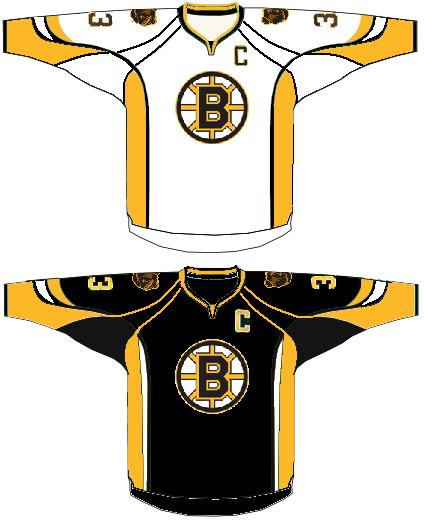
I must be blocking it out because I prefer to live within the darkest recesses of my own memory - next week's All-Star game isn't just your standard corporate schmooze-fest: the world will be introduced to the brand new revolutionary form-fitting uniforms for EVERY team! Yes, you heard it right - every team has been forced to redesign their uniforms to all follow the same pattern:


I can't vouch for the integrity here, but it sure fuels Sabres' fans fires - from http://www.gopetition.com/online/10455.html comes this:

Furthermore, Buffalo tried to bring back their original emblem into their new look, but Reebok told them "That it was impossible to do on their new form-fitting uniforms and went with the slug because it was smaller and viewable."
Here's an interesting article on how much the Sharks' players loved the new uniforms.

Yay.

UPDATE: the pics above are old, and not necessarily official. Turns out some of the players like the latest version of the jerseys:
NHL’s new duds get thumbs up from players

people: "All-Star" does not mean "best"

i've been out of commission for a while (still recovering from the Ontario weekend apparently) but the all star rosters were finally announced this week, and predictably what followed was my usual two-headed response of "what a sham" and "it doesn't mean a damn thing"

just as in recent years i've sadly cared less and less about things like the Hall of Fame (edwzipper over at SportsFrog had a brilliant writeup on the latest Baseball Hall of Fame lunacy - some day when i'm really bored i'll write a nice treatise on the ignorant process on voting for Hall induction), the All-Star game has also lost any charm it once had for me. It also falls under the enormous umbrella of "human fallibility" - anytime you allow people to be subjective about something you're going to see mistakes.

Fortunately, in any scheme a hockey allstar game means jack shit so the fact that Eric Staal and Simon Gagne get in while Marc Savard, Rod Brind'Amour, Thomas Vanek, and Max Afinogenov sit home is fine. I guess.

it's just that even the terms "star" and "superstar" at their core don't have true attachment to quality or talent. it has always had far more to do with popularity and/or notoriety than actual on-the-field/ice talent.


update: my treatise is unnecessary when others have done my work already - my bad on not mentioning the brilliance that is and has been the people at Fire Joe Morgan with regards to the Hall voting.

another update: the YoungStars game appears to be a far more palatable option than the actual All-Star game. A four-on-four contest pitting only players on their entry-level contracts, by definition the rosters would be less slanted towards the well-known and more results-driven. Thanks to HP for the link.

10 January 2007

OHL update - IceDogs to Niagara Falls?

"The Mississauga IceDogs junior A hockey team could call Niagara Falls their new home as early as this September, if the team’s owners and city council can make a deal to build a new 5,000-seat arena. "

full story from Niagara Falls Review in comments